Tiptap review: a headless editor framework you build the UI for
Tiptap is an MIT-licensed headless rich-text editor framework built on ProseMirror, shipping no UI of its own and exposing extensions instead; its React binding first appeared on npm in February 2021.
TL;DR
- Tiptap is a headless rich-text editor framework: it supplies the document model, commands and extension system, and supplies no toolbar, menu or button, because the interface is expected to be yours.
- We measured @tiptap/react 3.31.3 with StarterKit at 123.3 kB gzip; in our time-to-editor benchmark (3.30.2) it reached a rendered editor in 11 lines of application code and a median of 171 ms.
- It is a document editor, not a page builder: there is no canvas, no breakpoints and no style manager, so a landing-page requirement points somewhere else entirely.
Tiptap quick facts
| Type | Library |
|---|---|
| Licence | MIT |
| First release | 2020-11 |
| Language | TypeScript |
| Frameworks | Any (framework-agnostic) |
| SSR support | partial |
| Bundle size (min+gzip) | 123.3 kB gzip |
| Pricing | Free tier, paid plans undisclosed |
| Self-hosted | Yes |
| White label | Yes |
| npm weekly downloads | 13,973,443 |
| GitHub stars | 38,426 |
| Latest version | 3.31.3 |
| Last verified | 2026-08-20 |
What Tiptap is, and who it is for
Tiptap is what you reach for when the editing surface has to be yours. It gives you ProseMirror's document model wrapped in an extension system that is far more pleasant than ProseMirror's own API, and then it stops: there is no toolbar, no bubble menu, no slash command, no file uploader. Those are components you write against commands the framework exposes.
That makes it a strong fit for products where the editor is part of a designed interface — a knowledge base, a CRM notes field, a CMS body editor, an AI writing surface — and a poor fit for a team that expected to install an editor and see one.
It is in this dataset because it is routinely shortlisted next to Plate, Editor.js and Lexical, and because those four are frequently confused with page builders. They are not: a requirement containing the words "columns", "breakpoints" or "brand colours" belongs with GrapesJS or Puck instead.
Architecture: extensions over ProseMirror
An extension can contribute nodes, marks, keyboard shortcuts, input rules, commands and rendering behaviour, and extensions compose into a schema. StarterKit is a bundle of the common ones — paragraphs, headings, lists, bold, italic, history — which is why the getting-started example is so short.
Underneath sits ProseMirror, and that matters in both directions. It gives you a battle-tested, transaction-based document model with strong guarantees about valid state. It also means that when something behaves unexpectedly, the concepts you need are ProseMirror's: schema, transactions, plugins, decorations. Tiptap does not hide that permanently, and the documentation stops short of where ProseMirror's begins.
The framework-agnostic core with first-party React and Vue bindings is worth noting. Of the headless document-editing frameworks in this dataset, only Tiptap and Editor.js can serve a Vue product without community glue. The finished editors, CKEditor 5 and TinyMCE, also ship first-party Vue integrations — with a toolbar you did not design and a GPL-or-commercial licence attached.
Getting started
This is the file from our benchmark, unedited. Eleven lines — the shortest React integration of the eight applications we measured.
import { createRoot } from 'react-dom/client';
import { EditorContent, useEditor } from '@tiptap/react';
import StarterKit from '@tiptap/starter-kit';

function App() {
  const editor = useEditor({
    extensions: [StarterKit],
    content: '<h1>Hello editor</h1><p>Type here.</p>',
  });
  return <EditorContent editor={editor} style={{ padding: 16 }} />;
}

createRoot(document.getElementById('app')).render(<App />);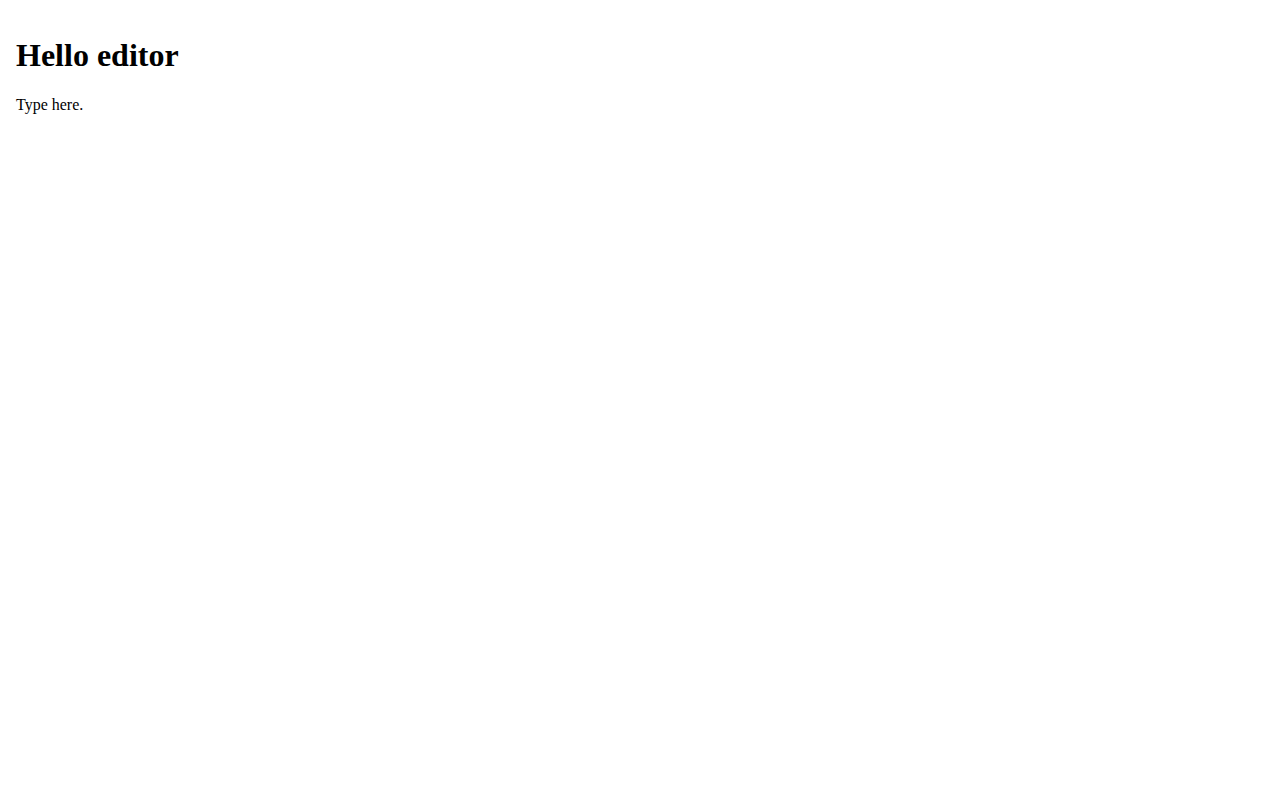
Tiptap 3.30.2 from the code above, screenshotted from our own build. There is no toolbar because Tiptap does not ship one — that is the product decision, not an omission.
Median 171 ms to a rendered editor. Compare that with Plate at 209 ms and Lexical at 159 ms: within this group the timings are close enough that they should not decide anything, and the benchmark page explains why we publish them anyway.
Strengths
The extension model is the whole API. Configure a list, get an editor. Adding a custom node type is one file, and the typed command API means mistakes surface at compile time.
Framework-agnostic core. First-party React and Vue bindings from one editing core, which no other headless rich-text framework here offers.
ProseMirror underneath. A document model with real guarantees, years of edge cases handled, and an escape hatch to raw ProseMirror plugins when the extension API is not enough.
Documentation organised by task. Each extension has a runnable example and an explicit install path — better than most libraries in this dataset.
A clear upgrade path for hard features. Collaboration, comments and AI exist as maintained products rather than as abandoned community experiments.
Limitations
No interface, at all. Toolbars, bubble menus, slash commands, link dialogs and upload handling are your code. For a designed product this is the point; for a team on a deadline it is a surprise, and it is the single most common reason Tiptap gets swapped out again.
Heavier than the minimal comparison suggests. 123.3 kB gzip for the React binding plus StarterKit, against Lexical at 104.9 kB and Editor.js at 64.3 kB. Realistic editors add extensions on top of all three.
ProseMirror leaks through. Not a flaw, but a cost: debugging unusual behaviour means learning a second mental model, and the documentation hands you off at that boundary.
Some expected capabilities are commercial. Collaboration, comments, AI and document conversion are paid services. That is a legitimate business model and it is worth establishing before a proof of concept assumes they are free.
Not a page builder. No canvas, no layout, no styling for end users. Worth repeating because the category names overlap.
Pricing
The framework and its open-source extensions are MIT licensed, free, with no ceiling. The hosted
services are separately priced; our verification pass did not capture the current figures, so the
dataset records paid_from_usd as null rather than an estimate.
For a hands-on comparison against the closest alternatives, see Tiptap vs Lexical, Plate vs Tiptap and Editor.js vs Tiptap.
Who Tiptap fits, and who it does not
Good fit
- Products that need a rich-text editor whose interface is entirely their own, because Tiptap ships no UI to override
- Teams that want the same editing core across React and Vue rather than one library per framework
- Editors that will grow collaborative features later, since real-time editing is a supported path rather than a rewrite
Poor fit
- Page building, because there is no canvas, no layout primitives and no style manager anywhere in the framework
- Teams that want a toolbar and menus on install, since building the interface is the deal Tiptap offers
- Products that need email-safe HTML output rather than structured document content
Our scores for Tiptap
Scored 0–10 by the EditorStack team against the rubric on the methodology page. Each score is argued below it; a score with no argument fails the build.
- Developer experience8.5/10
The extension model is the whole API and it is coherent: configure a set of extensions, get an editor instance, render it where you like. Our benchmark reached a working editor in eleven lines. The friction is that being headless means every visible control is your code, and that reality arrives immediately after the first render.
- Extensibility9/10
Extensions reach schema, keyboard handling, input rules, commands and rendering, and ProseMirror sits underneath for anything the extension API does not cover. Very little requires a fork, and the escape hatch to raw ProseMirror plugins means the ceiling is effectively the ceiling of ProseMirror itself.
- Documentation8.5/10
Documentation is organised by task with runnable examples per extension and explicit installation paths, which is unusual in this category. It thins out where ProseMirror concepts leak through — schema design and transaction handling assume you will read upstream documentation eventually.
- Ecosystem8/10
A large first-party extension catalogue covers most document requirements, and community extensions are plentiful because the ProseMirror community overlaps. Some capabilities teams expect for free — collaboration, comments, AI — are commercial services rather than open extensions, which is worth establishing before adopting.
- Time to production7.5/10
A functional editing surface takes hours; a product takes longer because toolbars, bubble menus, slash commands and upload handling are all yours. That is the same trade Craft.js makes for page building, and it prices out similarly: fast to something working, slower to something shippable.
Tiptap against its nearest neighbours
The closest products in the dataset by category, with the facts most people open three tabs to compare. Bundle sizes marked in kilobytes are our own measurements.
Alternatives to Tiptap
Each comparison below is a full write-up, not a feature grid: where each tool wins, and what moving between them costs.
Frequently asked questions
- Is Tiptap free?
- The editor framework and its open-source extensions are MIT licensed with no usage ceiling. Tiptap separately sells hosted services — collaboration, comments, AI, document conversion — on paid plans, and those prices were not captured in our verification pass, so we record them as null rather than guess.
- How big is Tiptap?
- We measured @tiptap/react 3.31.3 together with StarterKit at 123.3 kB gzip (raw figures are in the dataset), with React treated as external because a React application already ships it.
- Tiptap or Lexical?
- Tiptap is faster to something usable — 11 lines against 25 in our benchmark — and has the larger extension catalogue. Lexical has the smaller core and a stricter state model. Our head-to-head compares them directly.
- Does Tiptap work outside React?
- Yes. The core is framework-agnostic with first-party React and Vue bindings, which is unusual among the headless rich-text frameworks in this dataset — Plate and Lexical's React binding are both React-specific. CKEditor 5 and TinyMCE also have first-party Vue integrations, but they are finished editors rather than frameworks.
- Can Tiptap build landing pages?
- No. It has no canvas, no layout primitives, no responsive breakpoints and no style manager. Products that need those want GrapesJS or Puck, and the comparison pages set out where the line falls.
Sources and verification
Last verified: . Facts on this page were checked against the sources below on the date shown next to each one.
- npm registry metadata for @tiptap/react (MIT licence, first publish date, latest version) — accessed 2026-08-20
- npm registry metadata for @tiptap/core (first publish date November 2020) — accessed 2026-08-20
- Tiptap documentation — accessed 2026-08-20